AI in the Public Sector: Global Readiness, Governance, and Happiness (2024)
This data analysis project investigates the global landscape of Artificial Intelligence (AI) adoption in the public sector by addressing a core research question:
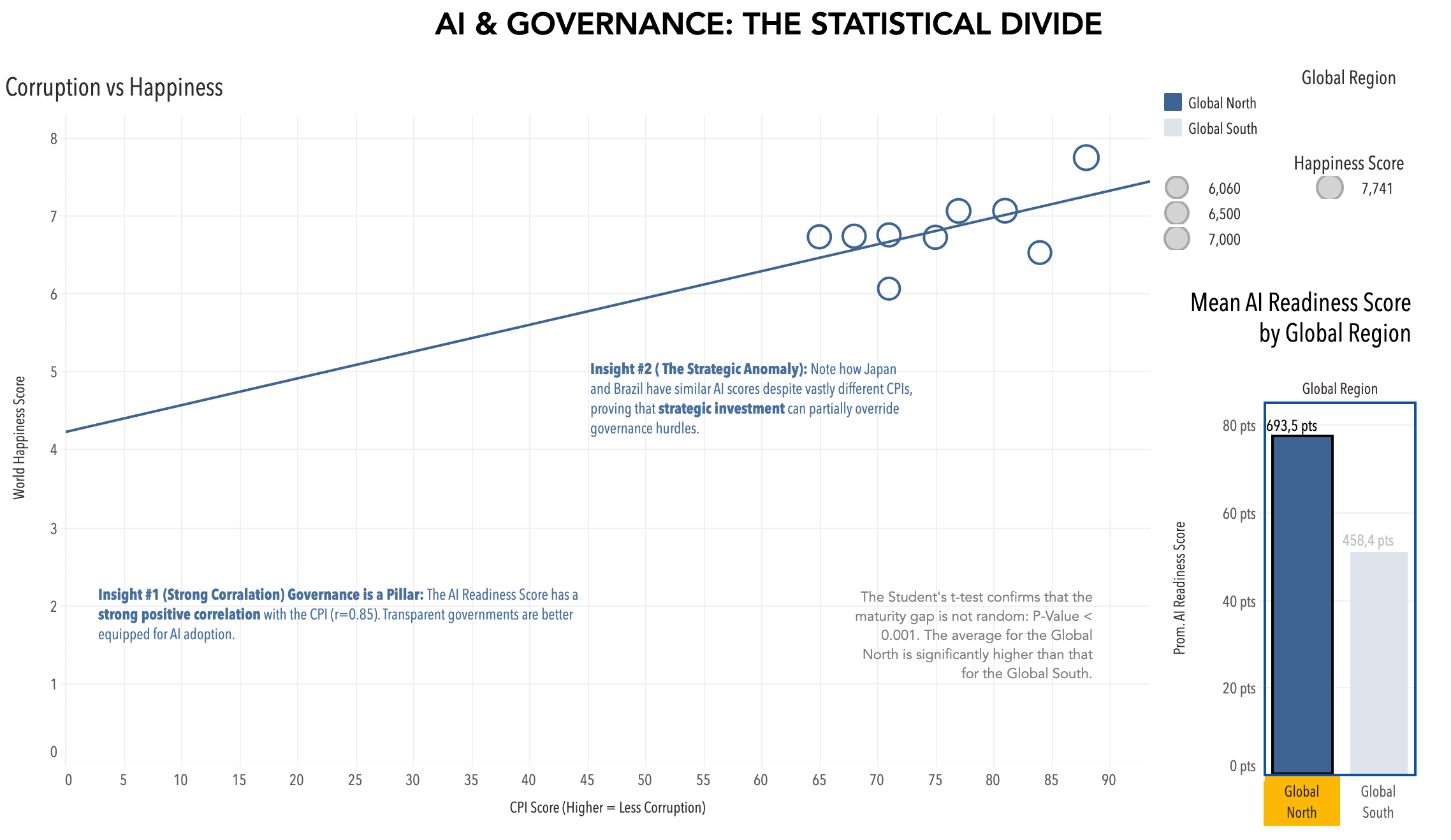
Is the gap in Government AI Readiness between the Global North and Global South statistically significant, and how strongly does this readiness correlate with government quality metrics like Corruption Perception and Citizen Happiness?
The analysis utilizes data from global indices to measure the relationship between technological maturity and the fundamental elements of good governance.
Key Findings
Statistically Significant Gap: A Student's T-Test confirmed a statistically significant difference (P<0.05) in AI Readiness Scores between Global North and Global South nations, proving the gap is a real global phenomenon.
Governance as a Predictor: A strong positive correlation (r=0.85) was found between the AI Readiness Score and the Corruption Perceptions Index (CPI). This indicates that countries with lower perceived corruption and higher transparency are significantly better prepared for public sector AI adoption.
Predictive Model: A Linear Regression Model was created using the CPI score as a predictor for AI Readiness, with a significant slope (≈0.59). This model demonstrates the predictive power of governance quality over technological maturity.
The Strategic Factor: Outlier analysis (e.g., Japan vs. Brazil) showed that while governance is key, strategic investment and existing infrastructure can also drive AI readiness, sometimes overriding differences in corruption scores.