AI Investment Analysis: Strategy, GDP, and the Global Innovation Gap
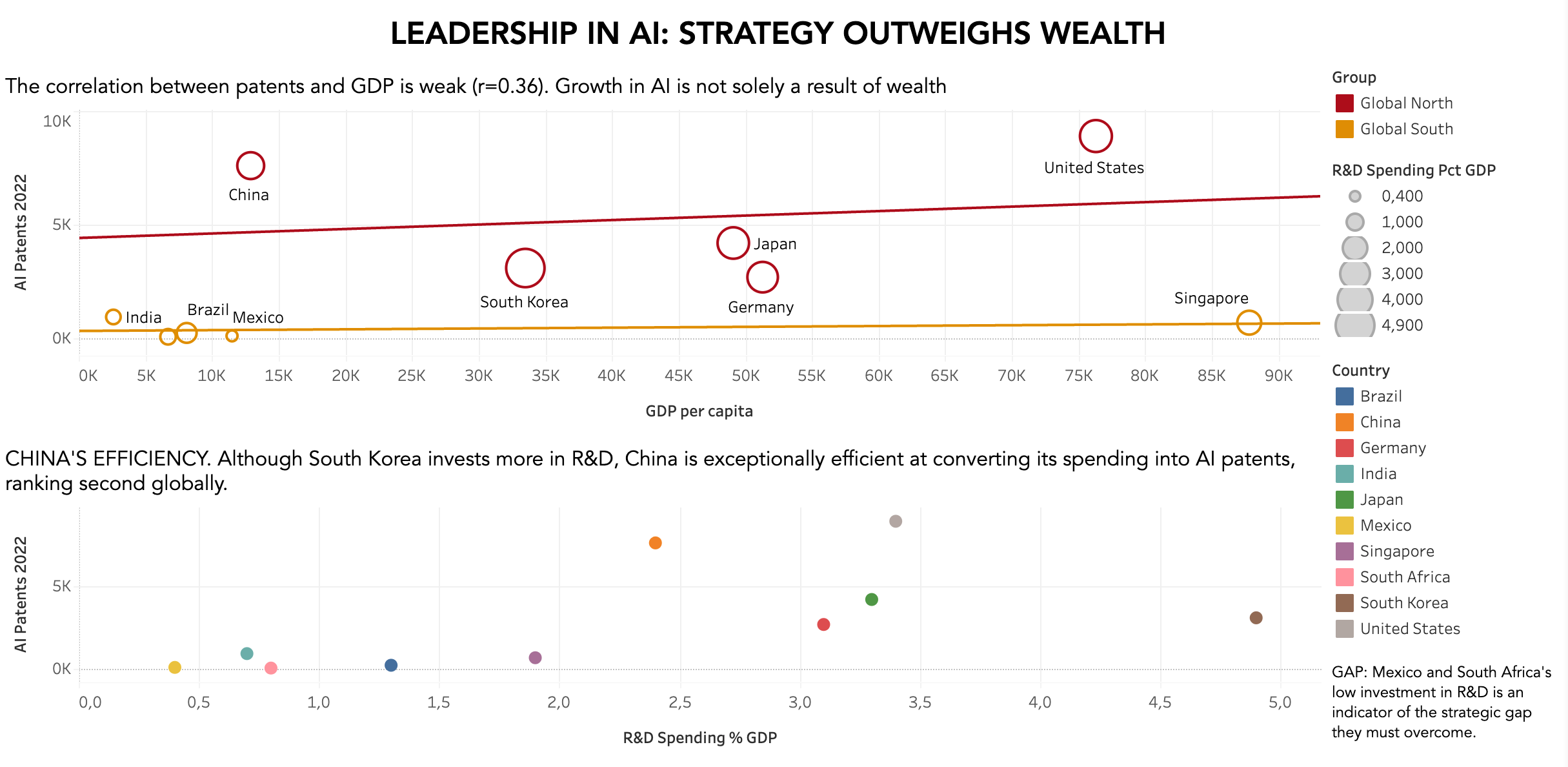
This project provides an in-depth comparative analysis of Artificial Intelligence (AI) patent production across major global economies. The core objective is to move beyond simple correlations of wealth and innovation by investigating:
How strongly GDP per capita influences a country's AI patent output.
The role of strategic investment (R&D spending) in driving technological leadership.
The nature of the growing innovation gap between the Global North and Global South.
The findings highlight that technological leadership is a result of deliberate national strategy rather than just economic size.
Key Findings
The China Anomaly: The analysis revealed that China's AI patent production rivals that of Global North leaders (like the US) despite having a significantly lower GDP per capita. This demonstrates that strategic national prioritization of AI can override traditional economic constraints.
Weak Correlation: The correlation between GDP per capita and AI patents was found to be positive but weak (≈0.36), proving that the relationship is non-linear and imperfect.
R&D Efficiency: The scatter plot comparing R&D spending (% of GDP) to patents showed significant differences in efficiency, with countries like Japan and China being highly effective at converting R&D investment into AI intellectual property.
The Widening Gap: Temporal analysis (2015-2022) confirmed that the gap in AI patent production between the Global North and Global South is rapidly widening, emphasizing the need for aggressive investment in developing nations.